Welcome to Big Screen Classics, a blog devoted to discussions and reviews of classic and not-so-classic Hollywood movies on both the big screen and your home screen. Plus a whole lot more: movie soundtracks, home theater technology, and whatever else crosses my mind. Your comments are welcomed and encouraged. Your host - Pete Apruzzese. Please note that we are not affiliated with TCM's "Big Screen Classics" movie series or the Lafayette Theatre.
Starring Joel McCrea, Randolph Scott, Mariette Hartley, Ronald Starr Music by George Bassman Cinematography by Lucien Ballard Film Editing by Frank Santillo Written by N.B. Stone Jr. Produced by Richard E. Lyons Directed by Sam Peckinpah
Blu-ray Disc Specs: AVC-encoded 1080p/2.35 widescreen/DTS-HD 2.0 mono/optional English subtitles/Street Date: 4/4/2017/$21.99 srp/Warner Archive Collection
Film information: Released by MGM/94 minutes/1962/Metrocolor/CinemaScope
I'm very pleased to offer a few words about a terrific new Blu-ray release from the folks at the Warner Archive Collection: Sam Peckinpah's RIDE THE HIGH COUNTRY starring Joel McCrea and Randolph Scott. It was released back on Blu-ray in April and I finally got this on the big screen the other night. It's a western set in an indeterminate time period but definitely the same end-of-the-west era as "The Wild Bunch" since there are also appearances by motorcars early on. While it seems it might be a conventional western - man hired to guard a gold dust shipment hires an old friend as his backup yet the old friend has something else on his mind - it's much more than that. The movie is simply phenomenal - it comes alive through the history that's etched in the faces of our two leading men. Scott relishing the thought of convincing his friend to abscond with the gold... McCrea reciting that he just wants to "Go into my House justified" - fantastic moments from these two screen legends at the end of their careers. I got a genuine thrill when Scott comes riding back in to rescue his partner; sitting there alone and I wanted to cheer like I did the first time I saw it 35 years ago. [For you kids, it's like when Han Solo unexpectedly comes back to help Luke during the attack on the Death Star in Star Wars...but even better.]
As for the Blu-ray, wow, what a beautiful transfer (aside from the windowboxed main titles which is wholly unnecessary at this point with flat screens). I don't have a reference other than seeing 35mm repertory prints back in the 80s, and the old DVD, but this Blu-ray looks fantastic color-wise and every other-wise. Detail and stability are perfect. Warner says that this is a brand-new film scan and mastering and nothing on-screen betrays that. Audio is DTS-HD MA 2.0 mono and is likewise solid. The disc has an audio commentary by the 'Peckinpah mafia': Paul Seydor, Nick Redman, Garnet Simmons, and David Weddle which I sampled for a few minutes - it's full of details about Peckinpah and the production of the film so I look forward to listening to it in its entirety some day...maybe after I retire. There's also a 23 minute featurette entitled "A Justified Life: Sam Peckinpah and the High Country" which was produced for the 2006 DVD release and tells about Sam's early life via clips, photos, etc., interviews with his sister, and more. Pretty essential viewing for a Pekinpah fan as it gives a good insight into his personal history that fuels the themes of many of his films.
Don't hesitate...this is one of the great ones. Get it right now.
From the box copy: Newly Restored in HD and 3-D from 2K Scans! A married woman (Agnes Moorehead) takes her four unmarried redheaded daughters (Rhonda Fleming, Teresa Brewer, Cynthia and Kay Bell of The Bell Sisters) to Alaska during the 1898 Gold Rush so they could help their father run his newspaper. All four are members of the singing sister act The Edmonds Sisters, and upon arriving in Yukon they find out their father was murdered. The four heroines get work at the saloon owned by Johnny Kisco (Gene Barry). Kathie Edmonds (Fleming) searches for her father's murderer, who may or may not be Kisco. Hollywood veteran Lewis R. Foster directed this wonderful and colorful musical, which was the first ever 3-D musical and the first widescreen film released by Paramount Pictures. Special Features: Audio Commentary by Film Historians Hillary Hess, Greg Kintz, Jack Theakston and Bob Furmanek | 2006 Interview with Rhonda Fleming | Before/After Restoration Demo | Original Theatrical Trailer
-----
Bob Furmanek of the 3-D Film Archive was kind enough to share with me a final check disc (a clone of the actual retail product) for the upcoming Blu-ray 3-D release of the 1953 musical THOSE REDHEADS FROM SEATTLE for review. Kino Lorber, in association with the 3-D Film Archive, licensed the film for release from Paramount who supplied new 2K scans of the original left & right elements for final restoration by the 3-D Film Archives team. Note that as with all 3-D Blu-ray releases this is also view-able in 2-D on all systems.
As usual for these reviews, I'm not going to comment extensively on the film itself. While no one would mistake it for an Arthur Freed MGM production, the film is still a winner based on the enthusiasm and energy of the performances. Gene Barry (who doesn't sing), Rhonda Fleming, Agnes Moorehead, Teresa Brewer, The Bell Sisters, and Guy Mitchell are charming and I enjoyed my time with them. Safe to say that if you enjoy musicals, you'll find much to like here even though there are only five or six musical numbers. The western mining town location offers considerable opportunity for outdoor action and interior decoration (a combination bar/music hall stage) for the cast to work in.
What is of significant interest with THOSE REDHEADS FROM SEATTLE is the resulting 3-D Blu-ray experience and it's nothing short of terrific. It features wonderful depth with several fun off-screen moments (yes, including the dancers' legs - for once a movie poster didn't completely lie). As with the majority of the 1950's "Golden Age of 3-D" movies, the original stereoscopic photography (by Lionel Linden) is superb and features a marvelous use of depth-layering compositions to give a genuine "you are there" feel to many scenes. After viewing this disc - the first time I've seen the film in 3-D in about 10 years - I would place its 3-D photography in the top ten of the Golden Age.
Top - before color correction; Bottom - after color correction
The restoration demo on the disc's special features presents the Archives' Greg Kintz detailing many of the problems they encountered while restoring this film. Just this before-and-after image should give you a small idea of the results, but there was much more done including vertical alignment (which reduces eyestrain), dust/debris cleanup (by Thad Komorowski), panel matching, etc. This section is easily my favorite part of the special features since it clearly shows how much work went into the restoration of the originally intended look of the film. There may be naysayers who claim that these Blu-ray 3-D restorations can't be performed at the budget the Archive works with, but the results on display here belie this view.
The Blu-ray also features a newly-created lossless DTS-MA 3.0 reconstruction of the original three channel (left-center-right) stereophonic soundtrack plus, in a move which makes my purist heart happy, it also contains the original mono track in lossless form. Bob tells me that the original three channel sound was lost years ago, so audio engineer Eckhard Büttner took the original music and sound elements and was able to create a convincing stereo sound field from them, including some directional dialogue, The result is terrific, even in critical listening mode I wouldn't have guessed it wasn't the original stereo. There is none of that "electronically reprocessed for stereo" sound effect that we all hated on records from the 50s and 60s, nor did they try to create a modern booming 5.1 sound mix. What's there is natural-sounding to the era of the film's creation. This is an outstanding 1950s film soundtrack.
Special Features:
Interview with Rhonda Fleming from 2006.
Restoration demonstration, hosted by Greg Kintz (noted above), view-able in 3-D or 2-D.
Audio commentary, featuring film historians Bob Furmanek, Hillary Hess, Jack Theakston. This is a very informative track that is the first commentary on a 3-D Blu-ray that concentrates on the 3-D production of the film as well as the history of the 3-D Film Archive. Greg Kintz joins at the intermission and provides additional details about both the film and the Archive's restoration efforts. An interesting item that Hillary picks up on is the extensive use of mirrors and windows in many shots, which really come alive in the 3-D presentation.
Theatrical Trailer (not looking anything like the feature)
Visual/audio demonstration of the three-channel stereo sound reconstruction.
In case it's not clear from all of the above, I heartily recommend the 3-D Blu-ray of THOSE REDHEADS FROM SEATTLE. no lover of vintage 3-D will want to be without it. You'll find more historical information about the film and its release at the 3-D Film Archive's website HERE.
All images courtesy of the 3-D Film Archive. Reviewed on an Optoma HD50 DLP projector, custom-built 1.0 gain acoustically-transparent screen, Denon processor/amplifier, Polk and Paradigm speakers. 3-D viewed via Estar & True-Depth DLP-Link and Optoma RF glasses.
8/30/16 UPDATE: Bob Furmanek just announced the following update: The upcoming 3-D Blu-ray release of IT CAME FROM OUTER SPACE is Region-free and has the following extras: 3-D trailer, 2002 featurette on the history of the film, commentary track by historian Tom Weaver and closed-captioning! It is also available from Amazon Canada and Amazon UK. -----
This post is just a little preview of the upcoming 3-D Blu-ray release of the 1953 favorite IT CAME FROM OUTER SPACE, coming on 10/4/2016 from Universal Home Video and available initially as a retail exclusive atBest Buy (link updated 9/15), with general availability at other retailers to be announced at a later date.
[Note that this will not be the red/green anaglyph conversion from the 1970s that came out on VHS tape at one time, but a modern Blu-ray 3-D version of the original dual-strip film elements.]
I was recently granted the opportunity to see a preview of the final 3-D Blu-ray master that will be used for this release. Bob Furmanek, head of the 3-D Film Archive, invited me plus several others to view the master on his setup utilizing an Epson 5030 LCD projector running an image about 8 feet wide.
The results, courtesy of Archive Technical Director Greg Kintz's 3-D alignment and panel matching, are nothing short of superb. I ran a 35mm dual-strip Polarized print at the Lafayette Theatre, plus I've seen it several times via this same process, and the 3-D Blu-ray is even better. Greg managed to correct 99.9 % of the errors in the original (there is one shot that Bob described as being impossible to fix - I think it lasts 4 seconds - and I didn't notice it while we watched the movie) and it just looks great.
And there's a huge upgrade in the sound department - they were able to access the last surviving element of the original 3-track stereo master (Left-Center-Right) and have preserved the original - v e r y w i d e - dynamic range and channel placement. The previous DVD used a tamed-down version of this mix and hearing the Blu-ray is a revelation.
I'll follow up this post with a full review when the Blu-ray hits the street, but this posting can serve as a preview and assurance that you can safely pre-order this science fiction classic with confidence.
For more information about the film and its history, go to the 3-D Film Archive.
Saved from near-oblivion by the 3-D Film Archive, the science fiction favorite GOG gets a new lease on life via this stunning 3-D Blu-ray from Kino Lorber Studio Classics GOG Blu-ray 3D specifications
Distributed By: Kino Lorber Studio Classics
Video Resolution: 1080p high definition
Presented in original theatrical 3-D or alternate 2-D
(GOG, 1954, directed by Herbert L. Strock, written by Tom Taggart and Richard G. Taylor from a story by Ivan Tors, produced by Ivan Tors, photographed in color & Natural Vision 3-D by Lothrop B. Worth, 1.66:1 aspect ratio, music by Harry Sukman; starring Richard Egan, Constance Dowling, Herbert Marshall, John Wengraf, Philip Van Zandt, Michael Fox, William Schallert; theatrically released by United Artists)
Studio Synopsis
In a remote, underground research laboratory two scientists, engaged in space travel research, are frozen to death in a cold chamber when their instruments comes under the control of an unknown power. A security agent, Dr. David Sheppard (Richard Egan, The 300 Spartans) arrives at the secret space research base, home of two experimental robots to investigate the possible sabotage. Early in his investigation, Sheppard finds that the underground laboratory under the control of the Supercomputer NOVAC and experimental robots GOG and MAGOG. Herbert L. Strock (The Crawling Hand) directed this Sci-Fi/Horror classic with a stellar cast that includes Constance Dowling (Black Angel), Herbert Marshall (The Letter) and William Schallert (TV's "The Patty Duke Show").
About the film
Fans of early 1950's science fiction films are in for a treat with this new Blu-ray release of Gog, the third in producer Ivan Tors' OSI Trilogy (The Office of Scientific Investigation): The Magnetic Monster (1951), Riders to the Stars (1953), and Gog (1954). The trilogy presented hard science fiction ideas in an entertaining - and occasionally juvenile - manner, surrounded by laboratory equipment, stoic leading men, lots of exposition, and colorful action. Gog is the culmination of the trilogy, telling its story of an underground space exploration lab besieged by unexplained sabotage. Is it caused by the Commies or an alien invasion? In 1954, you paid your 49 cents on a Saturday afternoon matinee and waited to find out. But unless you were in one of five California theaters, you didn't get to see Gog in its intended 3-D form. Its dimensional release was severely curtailed by distributor United Artists as it was coming at the very end of the 3-D craze.
Featuring an intriguing circular multi-level lab - which must have inspired the very similar design in Michael Crichton's novel and film of The Andromeda Strain - Gog was still a visual treat even in 2-D, color & widescreen and was fondly remembered by science fiction fans. Those fans were ill-served by the the film's television distribution where the majority of the prints were converted to black & white. During the DVD era, MGM released it via their manufacture-on-demand service, but again in only full-frame open-matte 2-D (harming the intended widescreen compositions) and from an element that had seen better days. For years, there didn't seem to be any hope to ever see the film again in 3-D. But that's where the story takes a happy turn and things get interesting.
About the Blu-ray & Restoration
As described in the Restoration Featurette on the disc, Gog was lost in its 3-D version for many years as the studio only maintained materials for the "right eye"; remember that 3-D movies contain two separate images: a "left eye" and a "right eye". The 3-D Film Archive tracked down the last surviving left eye print - in a totally faded-to-pink condition - nearly five decades later. Working in cooperation with MGM (who now owns the film) and supported by Kino Lorber, Bob Furmanek and Greg Kintz of the Archive began a months-long restoration to bring the film back to 3-D life for a Blu-ray release. Using numerous proprietary techniques, the Archive was able to return color to the left eye and then do a painstaking shot-by-shot matching of the color, image alignment, and cleanup of debris on the left and right prints. The result is an outstanding 3-D presentation on the Blu-ray. I was been lucky enough to see the original 3-D print a number of years ago in dual-projection polarized 35mm and this version gives a far better representation of the original film. The full story is told in the restoration featurette on the Blu-ray and on the Archive's website.
Lobby Card image courtesy of the 3-D Film Archive
Belying the myth the 3-D films from the 1950's were always filled with eye-poking off-screen effects, Gog instead uses depth to draw the audience into its environment. The staging of the scenes emphasizes the size of the underground laboratory. The use of depth betrays the low budget the film was produced under - all the sets look larger than they really are. Many scenes have multiple layers of action showcased - there's a particularly striking sequence about 7 minutes in that shows foreground action, background action and then another level of depth shot through a window. This type of depth exploitation has rarely been used in modern Hollywood 3-D films, with the possible exception of Martin Scorsese's Hugo, and is sorely missed. When the action gets moving in the final third, we are treated to a good selection of off-screen effects: notably a flamethrower and the wild gesticulating arms of the rampaging robots. Director Herbert L. Strock suffered from monocular vision (just as House of Wax's Andre de Toth did) so he relied on cinematographer Lothrop B. Worth (plus Natural Vision Supervisor M.L. Gunzberg, visual consultant Julian Gunzburg M.D., and Natural Vision consultant O.S. Bryan) to help him stage scenes to maximize the 3-D effects. The result is one of the best photographed 3-D films of its era, certainly equal to the efforts of the major studios. And all of it is presented for you ghost and artifact free on this Blu-ray.
Bonus features on the Blu-ray include an informative Audio Commentary by Tom Weaver, Bob Furmanek and David Schecter; a lengthy featurette on the restoration, archival interviews with director Herbert L. Strock and cinematographer Lothrop B. Worth, and trailers.
For fans of vintage 3-D, you can't go wrong with GOG. Highly recommended - buy it now.
Here is a brief peek at the restoration (the full version of the Restoration Featurette is on the Blu-ray; as an added bonus this short is filmed and presented in 3-D):
The original trailer (unrestored version):
For even more information on Gog, visit the 3-D Film Archive website.
Reviewed via a Vivitek DLP 1080p 3-D projector (ISF calibrated), EstarAmerica DLP-Link glasses, custom acoustically-transparent screen (100" diagonal), Sony Blu-ray player, Denon receiver, Paradigm speakers.
Written by The Gordons, based on their novel "Operation Terror"
Music by Henry Mancini
Starring Lee Remick, Glenn Ford, Stefanie Powers
Review note - Very strange, I found this in my draft folder and realized I never published it so made a couple for quick revisions and here you go.
Studio synopsis
Experiment in Terror (1962) is director/producer Blake Edwards’s chilling excursion into atmospheric neo-noir, focusing on a San Francisco working girl (Lee Remick) stalked by a wheezing psychopath intent on forcing her to rob the bank where she works…or else. Fearing for the safety of her younger sister (Stefanie Powers) even more than for her own, our heroine pluckily makes secret contact with an FBI agent (Glenn Ford), hoping to foil the psycho before he can carry out his sinister threats.
About the film
Experiment in Terror is slick thriller brought to the screen with the best that Hollywood could offer. Featuring a strong and intelligent female lead, especially for its time, it has aged very well. The villain is a creepy psychopath who wouldn't be out of place in a David Lynch film (check out the Main Title sequence linked below for another Lynch reference) - and who might have inspired Dirty Harry's Scorpio Killer. I don't feel I should discuss too much more of the film's plot as it unfolds very deliberately and remains extremely suspenseful.
About the disc
Sony has provided the independent label Twilight Time with an impressive 1080p high definition transfer in the original theatrical aspect ratio of 1.85:1. The contrast and sharpness in the HD rendering of this black & white film are exemplary. Coupled with artifact-free authoring/mastering and you get a near reference quality image - this is one of the best high definition black & white film transfers I've viewed. The film's audio track is a new DTS-HD Master 5.1 remix (all original release prints were in mono) that uses the original stereo music recordings and mono dialogue/effects tracks. The stereo separation and surround usage is minor; the music, not surprisingly, is the chief beneficiary of the remix, particularly the creepy organ chord that plays as an undercurrent for the villain. Henry Mancini's menacing score, one of his best dramatic works, sounds terrific. It would have been ideal if Twilight Time had also included the original mono track (especially in lossless format), but Sony might not have offered that to them for this disc.
Extras include an isolated music track (in DTS-HD Master 2.0 stereo) and a quartet of trailers and TV spots that, surprisingly, do not spoil the plot. Julie Kirgo supplies a thoughtful essay about the film in the eight page insert, though it does contains major spoilers so don't read before watching the film.
This disc gets my highest recommendation - it's a limited edition of 3000 copies, and as of this date, is still available at Screen Archives (link above).
"Bunny Lake is Missing", 1965, produced and directed by Otto Preminger, written by John Mortimer and Penelope Mortimer, based on the novel by Evelyn Piper, theatrically released by Columbia Pictures, black & white, 2.35:1 Panavision widescreen, 107 min., starring: Laurence Olivier, Carol Lynley, Keir Dullea, Noel Coward, Martita Hunt, Finlay Currie, The Zombies
Studio package synopsis: Bunny Lake is Missing (1965) offers us director Otto Preminger’s dark view of a London less swinging than it is sinister; the script by John and Penelope Mortimer presents a dodgy kind of thriller, in which the central damsel in distress (Carol Lynley)—a mother who claims that her child has been snatched from school—may be mad, joining the ranks of eccentrics who surround her. Also starring Keir Dullea and Laurence Olivier as a steady-on police inspector, giving one of the more sneakily larcenous performances of his illustrious career.
Producer/director Otto Preminger was just coming off of several big productions - Exodus, The Cardinal, In Harm's Way - when he went to England to shoot Bunny Lake is Missing. In many ways it's a reversion to his earlier days when he was making stylish film noir thrillers such as Laura and The Fallen Angel. The central mystery in Bunny Lake (which, for obvious reasons, can't really be discussed here) is fascinating and just a little creepy. In fact the whole movie is creepy starting with the detached performance of Keir Dullea to the behavior of the worst neighbor of all time: Noel Coward's Wilson - a man with big touchy hands and threatening words. But probably the best example is a scene towards the climax set in a Doll Hospital (apparently a real place in London) where a kindly old man (Finlay Currie, from Ben-Hur and many other pictures) presides over a crowded shop full of disembodied and amputated dolls under repair. Skin-crawling stuff from Preminger and his writers.
2016 NOTE: I'm leaving up this post because it was true at the time it was written. However, as noted in this subsequent posting: Bye_bye Warner Archive Instant, I have retracted my recommendation of the service. ---------
Warner Archive Instant website home page
Review note: I have been a paying subscriber to this service since 2013
In this post I'll be taking a critical look at the Warner Archive Instant Streaming Video-on-Demand service . For those of you who like to flip to the end of the book first I'll save you the trouble: this is the essential streaming service for classic film fans.
OK, I'm getting a little ahead of myself here. Perhaps I should take the time to explain just what it's all about.
WHAT IS IT? A monthly subscription video streaming service - similar to Netflix, but featuring only titles from the Warner Archive library. The biggest difference between Warner Archive Instant (I'll refer to it as WAI from here on) and other streaming services is that it focuses exclusively on classic titles from the 1920s through the 1980s that are part of the Warner library. You won't find "Harry Potter" here but you will find "Home from the Hill," "Dark of the Sun," "Night Nurse," "The Unholy Three," "The Bad and the Beautiful" and many more.
Roku Streaming Box
HOW DO I GET IT? WAI costs $9.99 a month (even less if you sign up for 6 or 12 months) and has over 500 movie and TV titles available for streaming at any one time. You need a Roku streaming box (which start at around $50) to connect to your high-speed internet service and your HDTV. You can also watch via the WAI app for an Apple iPad (and if you also have an Apple TV, you can then use Apple's AirPlay to send it to your HDTV). Viewing on your computer is also available, though that is in standard definition only.
WHY DO I NEED IT? Like to watch classic movies from the Warner stable of studios (Warner, MGM, RKO, Allied Artists, and many more)? Like to watch High Definition films that aren't available on Blu-ray? Want a choice of viewing over 500 different titles at any one time? Then you want Warner Archive Instant.
Now it's time for some further details, so please continue reading after the jump.
Blu-ray specifications Distributed By: Kino Lorber Studio Classics Video Resolution: 1080p high definition Aspect Ratio: 1.85 widescreen (theatrical 1.85) Audio: DTS-HDMA 2.0 (mono) Feature Running Time: 79 minutes Blu-ray street date: 05/12/2015 srp: $29.95 Source: Reviewer purchased copy
("X" - The Man with the X-ray Eyes, 1963, directed by Roger Corman, written by Robert Dillon and Ray Russell, based on a story by Ray Russell, produced by Samuel Z. Arkoff & James H. Nicholson, theatrically released by American International Pictures)
Studio package synopsis:Dare To Look Into The Eyes Of Madness! Fantastic tale of heart-pounding suspense, this harrowing and terrifying sci-fi shocker will fascinate horror film fans. Starring Ray Milland, it charts the startling transformation of a doctor so blinded by ambition that he dares to glimpse eternity! When the brilliant Dr. Xavier (Milland) concocts a serum to improve human sight, he stumbles upon a formula for x-ray vision. Inspired by its awesome medical potential, but shunned by his short-sighted colleagues, the doctor tests the potion on himself, only to discover that his ability to see through walls, clothing and flesh is slowly eclipsed by and insatiable desire to look still further - even if it means seeing more than any mortal can bear!
Well, there's certainly a lot of exclamations in that description.
Something strange happened on the way to the making of this film. The usually exploitative Roger Corman (director of films as diverse as "Attack of the Crab Monsters" and "Swamp Women") became far more ambitious around 1960 when he started working with more literate scripts (by such luminaries as Richard Matheson and Charles Beaumont) for his series of films adapted from the works of Edgar Allan Poe, most starring Vincent Price. In the middle of all this Price and Poe, Corman found himself directing what would turn out to be a superior science fiction film, one that's nearly profound in its implications. While Corman's abilities as a filmmaker are generally strong he wasn't always known as a director with intellectual intentions but in the case of "X" he had a strong science fiction concept to visualize.
Running a tight 79 minutes, "X" benefits from a fully committed performance by Ray Milland (Academy Award winner for "The Lost Weekend" in 1945) as the doomed Dr. James Xavier. Other than the party scene where Xavier realizes he can see through everyone's clothing, the picture is generally free from comedy. It even achieves a certain melancholy feel in the final third, in particular the sequences set in the seedy carnival pier and when Xavier sets himself up in the slums to become a "healer" to the poor. While the special visual effects that are used to convey Xavier's new "sight" are not exactly state of the art, they are perfectly serviceable for the film and also contain few elements that certainly could have been influenced by the psychedelic drugs of the day. Corman regular Les Baxter is on-hand to contribute a strong music score. Note: the official on-screen title is "X" - the subtitle was only on the advertising and marketing.
Minted from a newly created (in 2014) HD transfer from MGM, Kino's Blu-ray of "X" is terrific. The picture quality (reproducing the original widescreen 1.85 theatrical ratio correctly) is solid, with only a few minor instances of dirt and debris cropping up - mostly in the optical effects and scene transitions - but never enough to detract from the film. Film grain appears to be well rendered with no visible artifacts that would indicate that overzealous digital processing was used. The two channel mono sound is flagged correctly to make capable audio processors automatically decode and route it properly to a single center channel speaker. Frequency extremes are somewhat limited, which is to be expected given the low budget nature of the film, and there is a trace of sound distortion in the early going that clears up. Overall, the transfer compares favorably to the excellent 35mm print I ran of this film back in 2013, so MGM must have quality elements on hand and did an excellent job preparing this master for Kino.
The Blu-ray has decent supply of extras on-hand: the theatrical trailer (and just what does "Filmed in Spectarama" mean, anyway?), a "Trailers from Hell" segment with Mick Garris, a spoiler-laden introduction from Joe Dante (to Kino's credit, there's a text screen warning the uninitiated to not watch it until after seeing the film), and two optional audio commentaries: one by Roger Corman (from MGM's DVD release in 2001) and a newly-recorded one by writer/publisher Tim Lucas. Also included is the rarely seen 5 minute prologue that was added to the initial TV prints to pad the short running time. Contrary to what's been in written in some reviews, the prologue was only for the television viewings and was not shown theatrically.
This Blu-ray from Kino Lorber Studio Classics is Highly Recommended.
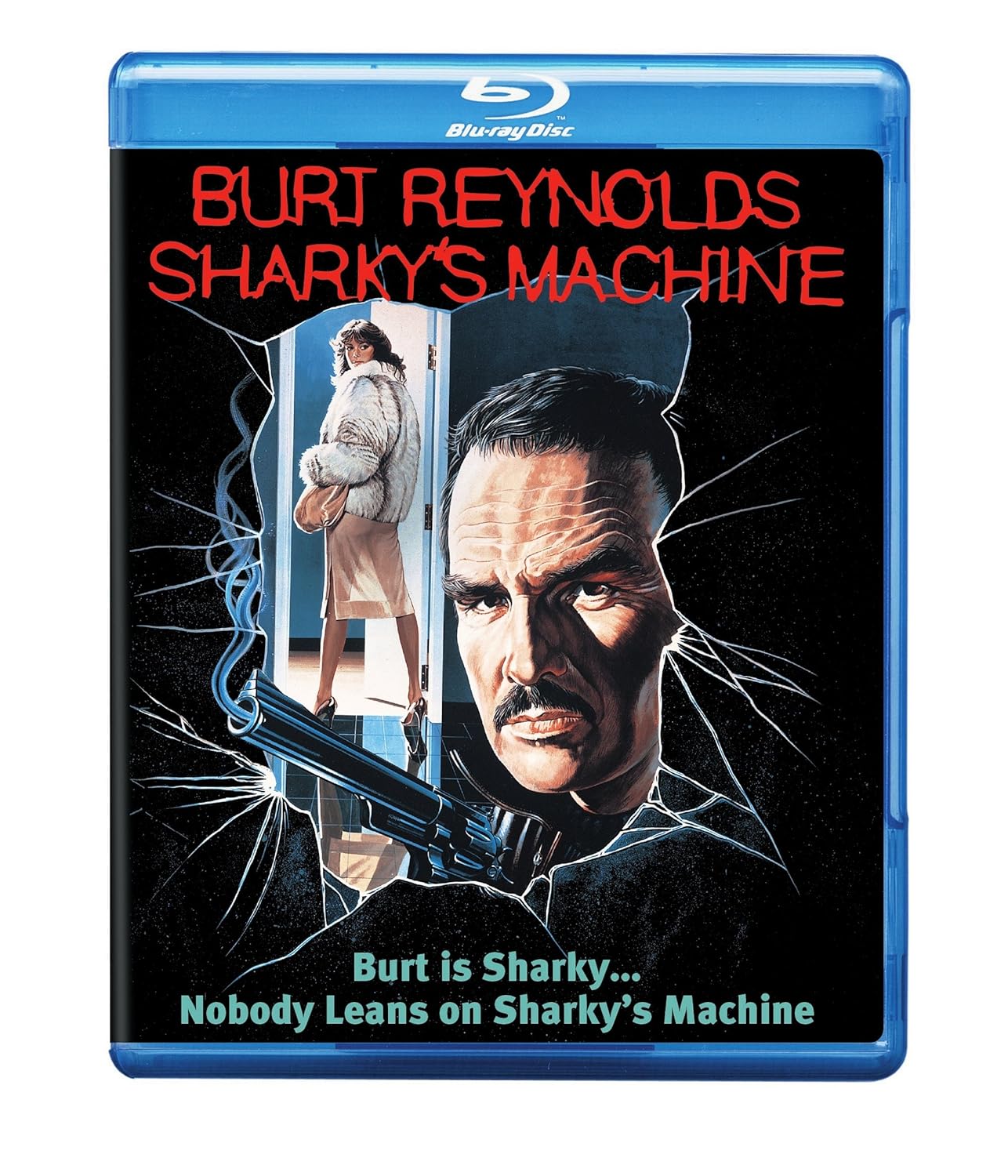
SHARKY'S MACHINE
(1981, directed by Burt Reynolds, written by Gerald Di Pego, based on the novel by William Diehl, Rated R)
Warner Home Video, Blu-ray release date 4/7/2015, $14.99 srp
Specs: 1.78 widescreen, DTS-HD Master 5.1 audio.
(Quick take review) Excellent long-awaited Blu-ray from Warner of this action film favorite from 1981 that has been treated poorly in the past on video with non-widescreen releases and indifferent audio. This Blu-ray has a near-perfect picture (some excessive film grain is noted in some shots but is likely on the source) and a big, wide, booming surround audio track that bring this gritty story to life. Reynolds directs (arguably his best effort behind the camera) and stars (also his best hairpiece) and acquits himself well. Some unfortunate and forced comedy bits intrude a little (and did Burt direct Charles Durning by simply telling him to yell through every scene?) but are redeemed by a terrific jazz score and a great location shooting (in Atlanta and surrounding areas). Rachel Ward is beautiful and memorable as Dominoe and Henry Silva and Vittorio Gassman are properly sleazy villains; great supporting cast includes Bernie Casey, Brian Keith, Richard Libertini, and Earl Holliman. Highly recommended on Blu-ray, avoid the old DVD at all costs.
Source: Reviewer purchased copy. Portions of this review previously published on Amazon.

 Starring Joel McCrea, Randolph Scott, Mariette Hartley, Ronald Starr